
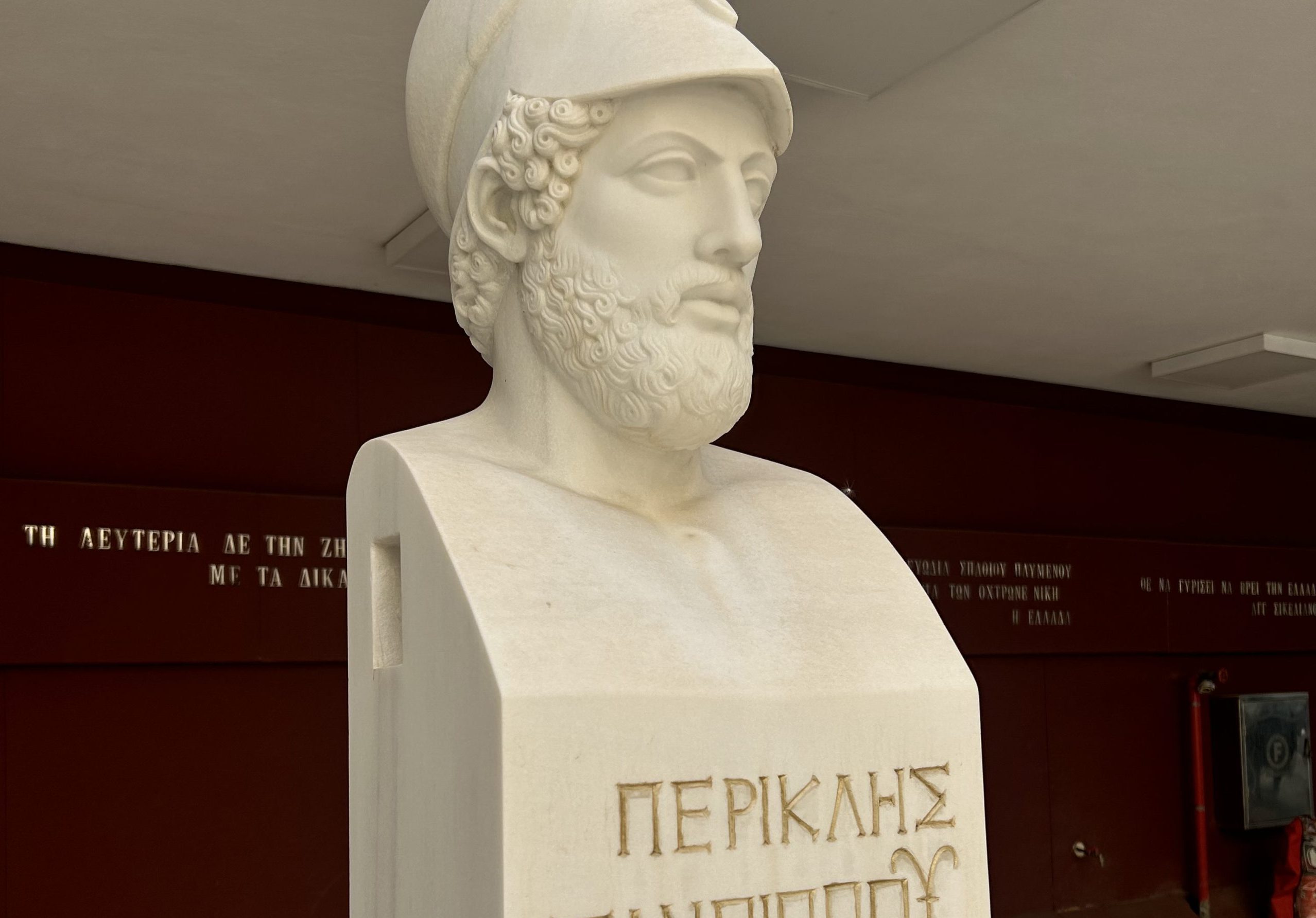
Pericles: The true architect of the Athenian Democracy
Pericles stands as one of the most influential figures in ancient Greek history. A statesman, orator, and general, Pericles lived during what is often referred to as the “Golden Age of Athens” (circa 495–429 BCE). His leadership, political reforms, and cultural patronage transformed Athens into the intellectual and artistic hub of the classical world. Despite being a member of an athenian aristocratic family he is often hailed as a founder and protector of Athenian democracy, Pericles’ vision went beyond military and political dominance; he sought to build a society where citizens were engaged, empowered, and proud of their city-state. This essay explores how Pericles emerged as a visionary leader and how his policies laid the foundation for one of the earliest forms of democratic governance.
Early Life and Rise to Power
Pericles was born into a wealthy and aristocratic family. His father, Xanthippus, was a military hero, and his mother, Agariste, belonged to the influential Alcmaeonid family. Educated in philosophy, music, and rhetoric, Pericles was deeply influenced by the teachings of Anaxagoras, a pre-Socratic philosopher who encouraged rational thinking and skepticism of traditional religious explanations. These intellectual foundations shaped Pericles into a thoughtful and strategic leader.
His political career began in the 460s BCE, a time of intense class struggle and social change in Athens. The democratic reforms initiated by earlier leaders like Solon and Cleisthenes had set the stage, but Athens was still grappling with inequality and aristocratic dominance. Pericles aligned himself with the democratic faction, advocating for the rights of the common citizens—particularly the thetes, the lowest class of free men who rowed the Athenian navy and formed its military backbone.
Champion of Democracy
Pericles did not invent Athenian democracy, but he significantly deepened and expanded it. His leadership marked a crucial phase in its development, often referred to as “radical democracy.” One of his key reforms was the introduction of misthophoria—state pay for public officials and jurors. This allowed even the poorest citizens to participate in public life, thereby making political engagement more inclusive.
Under Pericles, the power of the Ekklesia (Assembly), composed of male citizens, grew substantially. He limited the influence of the aristocratic Areopagus council and increased the authority of popular courts and citizen juries. Through these reforms, Pericles ensured that political power was no longer the domain of the elite, but a shared responsibility among all citizens.
His vision of democracy was not just procedural but also cultural. Pericles believed that democracy was a reflection of civic virtue. He encouraged citizens to be active participants in the political and cultural life of the city. As he famously said in his Funeral Oration: “We do not say that a man who takes no interest in politics is a man who minds his own business; we say he has no business here at all.”
Cultural Patronage and the Glory of Athens
Pericles’ vision extended beyond governance to the very soul of Athens. He saw the city as a symbol of human achievement, and he invested heavily in its cultural and architectural development. The most iconic of these projects was the construction of the Parthenon on the Acropolis, a temple dedicated to Athena, the city’s patron goddess. Funded partly through the Delian League, which Athens led, these building projects employed thousands and showcased Athenian wealth, power, and artistic excellence.
Pericles also supported the arts, literature, and philosophy. Under his patronage, Athens became the home of dramatic playwrights like Sophocles and Euripides, historians like Herodotus and Thucydides, and philosophers like Socrates. This flourishing of intellectual life was not accidental—it was nurtured by the freedom and civic engagement that democracy encouraged.
Visionary Leadership in War and Peace
Pericles was not only a statesman but also a capable military leader. He led Athens during the early years of the Peloponnesian War against Sparta. His strategy was defensive—relying on Athenian naval superiority and avoiding open land battles. Though controversial and eventually undermined by a devastating plague that claimed his life in 429 BCE, Pericles’ approach demonstrated his long-term vision. He believed that Athenian power lay not only in its military strength but in its unity, resilience, and democratic values.
His Funeral Oration, delivered during the war, remains one of the most profound expressions of democratic idealism. In it, Pericles praised Athens as a model for all of Greece, a place where freedom, equality before the law, and public service were sacred duties. This speech became a defining statement of civic pride and democratic commitment, resonating through history as a testament to the values he championed.
Legacy and Historical Impact
Though Athens’ democracy would eventually decline following its defeat in the Peloponnesian War, Pericles’ influence endured. His reforms laid a foundation that would inspire democratic thought for centuries. The principles of citizen participation, public debate, and equal justice became cornerstones of Western political philosophy.
Later political thinkers, from Enlightenment philosophers like Rousseau and Montesquieu to modern democracies today, have drawn inspiration from the Athenian experiment Pericles helped shape. His belief in civic responsibility, transparency in governance, and investment in cultural and intellectual life remain relevant in contemporary discussions about democracy and leadership.
Criticism and Limitations
Despite his achievements, Pericles was not without critics. His use of Delian League funds for Athenian projects was seen by some as imperialistic. The concentration of power in his hands—he was repeatedly elected as strategos (general) and wielded great influence—also raised questions about whether Athens was truly democratic or dominated by a single charismatic leader. Moreover, Athenian democracy excluded women, slaves, and foreigners, limiting the scope of its inclusivity by modern standards.
Nevertheless, within the context of his time, Pericles pushed the boundaries of political participation and civic equality more than any leader before him. His democratic vision, though imperfect, was a bold and transformative force in the ancient world.
Conclusion
Pericles remains a towering figure in the history of democracy—not as its inventor, but as its most dedicated cultivator and protector. His vision of a vibrant, participatory, and culturally rich society turned Athens into the cradle of Western civilization. His reforms empowered ordinary citizens, fostered artistic and intellectual excellence, and created a political legacy that has inspired generations. Through his leadership, Pericles demonstrated that democracy is not only a form of government but also a way of life, built on shared values, collective responsibility, and the pursuit of the common good.

Comment (0)